
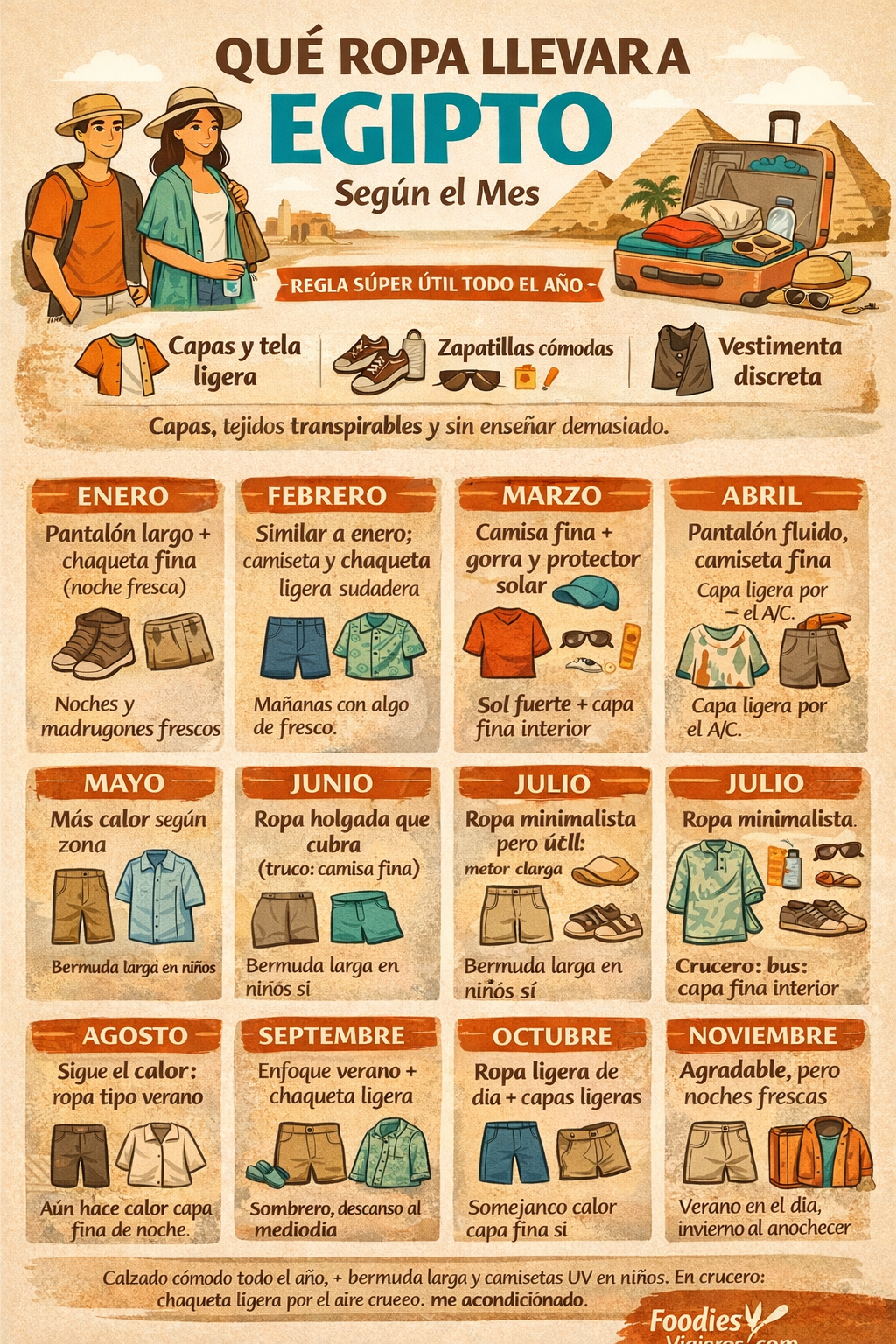
If you are organizing your trip and you are looking for a guide of what to wear to Egypt or how to dress in Egypt we tell you which garments work in Cairo, in the temples of Luxor/Aswan, during a cruise on the Nile (or Lake Nasser) and, if you include it, on the Red Sea.
| Season | Essential |
|---|---|
| Winter (Dec-Feb) | Long pants - T-shirt Light jacket - Thin sweatshirt - Comfortable slippers - Handkerchief - Socks |
| Spring (Mar-May) | Linen/cotton - Fluid pants - Thin shirt (long sleeve) - Cap - Sunglasses - Sunscreen - Extra light coat |
| Summer (Jun-Aug) | Light loose clothing - Thin long sleeves (sun) - Long shorts (optional) - Hat - Sunscreen - Sneakers Extra layer for A/C |
| Autumn (Sep-Nov) | Light clothing - Thin long pants - Shirt/overshirt - Night layer - Hat - Sunscreen - Sneakers |
Egypt is a very touristic destination, but in daily life clothing is usually more conservative than in Spain. For this reason, the best strategy is to dress with a practical modesty (no drama): be comfortable, protect yourself from the sun and avoid attracting unnecessary attention, especially in markets, non-touristy neighborhoods and religious sites.
In this article you have a complete guide General rules, what changes by zones, recommendations by months and a final checklist to prepare your suitcase without thinking too much about it.
- The rule that works all year round in Egypt: several layers and light fabrics.
- What to wear to Egypt by month (January-December)
- How clothing changes depending on the area: Cairo, Upper Egypt, cruise and Red Sea
- What to bring for temples and mosques
- Final checklist of suitcase for Egypt (family / couple version)
- What NOT to wear
- Frequently Asked Questions (FAQ SEO)
The rule that works all year round in Egypt: several layers and light fabrics.
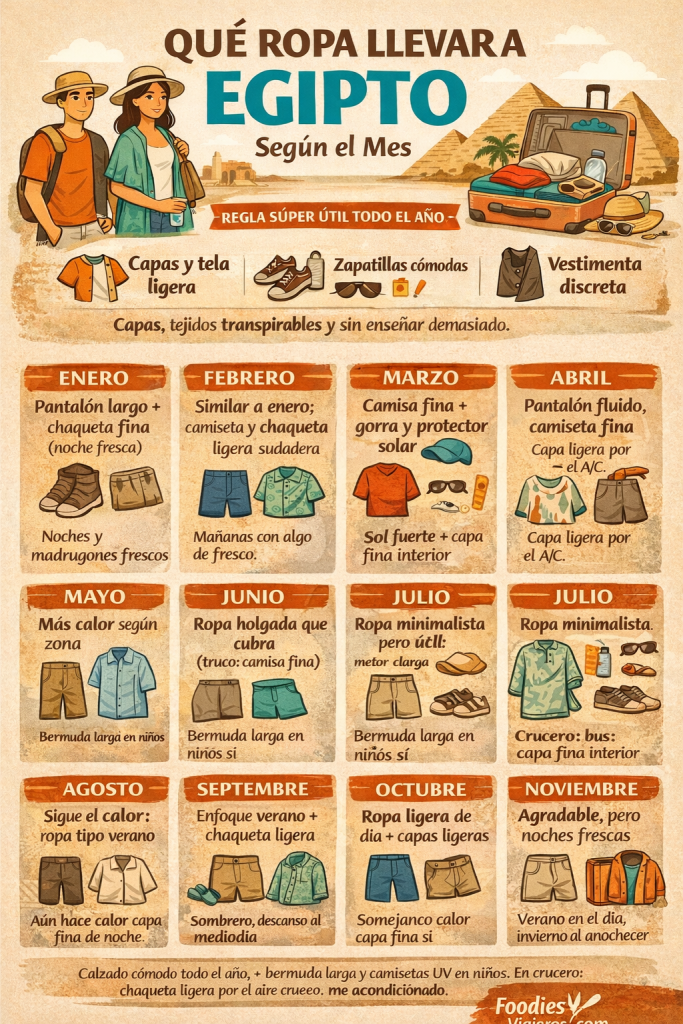
Before going into months, it is useful to understand why Egypt is “deceiving”: although it is a warm country, the climate is dry, the sun is intense and there are contrasts between outside and inside (buses, hotels and boats with strong air conditioning). Therefore, what works best for dressing in Egypt es:
1) Breathable fabrics and loose-fitting clothing. Cotton and linen are usually your best allies. In summer, tight-fitting or synthetic clothing quickly becomes uncomfortable.
2) Light layers A thin long-sleeved garment (overshirt, shirt, light jacket or cardigan) saves you for: cool nights, early mornings, air-conditioned interiors and windy/dusty excursions.
3) Dress discreetly In most situations, it is best to go with covered shoulders and knees. It is not an “official rule” for tourists, but it is usually the most comfortable socially, and avoids unnecessary friction in souks, local neighborhoods or when entering mosques.
4) Footwear prepared for walking: Visits to temples and archaeological sites involve many hours on your feet, with stones, steps and dust. A comfortable slipper (or comfortable closed shoes) is usually the best option.
What to wear to Egypt by month (January-December)
| Month | How it is usually | What to wear (adults) | Recommended extra (children / cruise) |
|---|---|---|---|
| January | Pleasant days, cold nights (early mornings are notorious) | Long pants + T-shirt + layer (light jacket/thin sweatshirt) | Children: extra layer + comfortable socks Cruise: A/C coating |
| February | Similar to January, somewhat milder at midday | Same as in January: long pants + T-shirt + layer for afternoon/evening | Children: thin sweatshirt Cruise: cape yes or yes |
| March | Very comfortable, but the sun is already beating down hard. | Lightweight clothing + fine shirt / overshirt, cap and protector | Children: cap + cream Cruise: light indoor coating |
| April | Excellent balance (ideal for circuits) | Lightweight and breathable garments + layer by air conditioning | Children: fine sweatshirt in buses Cruise: dinner/indoor cape |
| May | Heat rises, especially in Luxor/Aswan | Highly breathable fabrics + loose-fitting clothing; the better thin long sleeve what suspenders | Children: water + cap Cruise: thin layer |
| June | Strong heat in Upper Egypt | Thin pants or long shorts + light clothes that cover from the sun | Children: extra T-shirt + constant cream Cruise: A/C = layer |
| July | High heat + A/C contrasts | Minimalist but useful clothing: loose-fitting, light-colored + thin layer inside | Children: extra sweat shirt Cruise: thin sweatshirt |
| August | Very hot and strong sun | Avoid synthetics; clothing that covers without suffocating + sunscreen | Children: cap + frequent use cream Cruise: essential layer |
| September | The heat continues, it is starting to improve | Summer approach: light and loose + a little more margin at night | Children: light evening coat Cruise: inner layer |
| October | Another excellent month (highly recommended) | Lightweight daytime clothing + layer for night and cold interiors | Children: thin sweatshirt Cruise: dinner/indoor cape |
| November | Very pleasant, cooler nights | Light layering again: long pants + T-shirt + over-shirt | Children: cape and comfortable socks Cruise: layer |
| December | Mild days, cool nights | As for January: long pants + T-shirt + layer | Children: thin sweatshirt always comes in handy Cruise: layer |
How clothing changes depending on the area: Cairo, Upper Egypt, cruise and Red Sea
Cairo (large city)
In Cairo you can find everything, but as a practical rule you should choose a style that suits you casual discreet. For men, long pants and T-shirt/polo is usually perfect. For women, the same with low cut and minimal necklines. In both cases, a light open shirt or overshirt is a very useful wildcard: it covers you without being hot and adapts you to the “ambience” of the street effortlessly.
If you travel with children, in the city the most important thing is that they are comfortable and protected from the sun: breathable T-shirt, shorts or long pants depending on the season and a cap. If you want to avoid stares, very short shorts in children is not a “serious” problem, but on a practical level many families opt for longer shorts or thin pants.
Luxor and Aswan (temples, heat and trekking)
Here you will not get rid of the sun and early mornings, excursions, more intense heat and many hours outdoors. The best thing is clothing that covers the skin and breathes. One tip that works surprisingly well is to wear thin long sleeve (light shirt) instead of going bare-armed: it protects you from the sun, reduces the burning sensation and makes you more comfortable.
For children, it is also a good idea to bring an extra layer in case it cools down early and a reusable water bottle. In Egypt there is a lot of walking and children tend to get tired quickly.
Nile or Lake Nasser Cruise
What usually happens on cruises is “hot outside, cold inside”. That's why your suitcase should include an indoor layer: a light sweatshirt or thin jacket. You don't need elegant clothes, but you should bring a more “evening” garment if you feel like it: a comfortable dress, a shirt, a polo shirt...
Red Sea (Hurghada and similar)
In a resort the atmosphere is more relaxed. Swimwear and beachwear is the norm inside the hotel. For going out or moving around urban areas, it is usually more comfortable and appropriate to cover up with a light dress, a long T-shirt or an over-shirt.
What to bring for temples and mosques
In archaeological temples there is not usually a strict code, but it is best to wear sun protection clothing and road shoes. In mosques, legs and arms should be covered. For women, a scarf in the backpack may be useful in case you need to cover your hair when entering (or simply to feel more comfortable). For men, it also helps to wear long pants or long shorts and a T-shirt with sleeves.
Final checklist of suitcase for Egypt (family / couple version)
Basics for any adult (male or female)
- 2-3 light long pants (linen/cotton) or 1 long trousers + 1 long bermuda shorts depending on season
- 4-6 T-shirts or polo shirts
- 1-2 thin shirts (better if one is light long sleeve)
- 1 thin jacket / light sweatshirt (air conditioning + nights)
- 1 large handkerchief (joker)
- Comfortable walking shoes + sandal (optional)
- Cap, sunglasses, sunscreen
Extra if you travel with children
- 1 extra change “just in case” every day or every other day (they sweat and stain more).
- Cap mandatory + sunscreen
- Thin sweatshirt for buses and early mornings
- Comfortable closed footwear (temples) + sandal if you go to the beach
- Small reusable bottle
Extra if you cruise
- Air conditioning garment (very important)
- Small backpack for excursions
- Something “a little more dressed up” for dinner if you feel like it (not mandatory).
What NOT to wear
- Synthetic fabrics in warm months
- Very short shorts in town (best reserved for resort/beach)
- Very open shoes for temples if dust bothers you
- Tight-fitting clothing if you are looking to move without uncomfortable looks
Frequently Asked Questions (FAQ SEO)
How to dress in Egypt so as not to look out of place?
With comfortable and discreet clothing: shoulders and knees covered is usually the most practical in the city and cultural visits. In resorts there is more freedom.
What to wear to Egypt in summer?
Lightweight, loose-fitting clothing, ideally covering from the sun. Add a thin layer for air-conditioned interiors.
What to wear in Egypt in winter?
Layers: during the day you can be comfortable, but in the evening it gets cooler. Light jacket or thin sweatshirt.
Do children have to be “covered”?
There is no formal requirement for children, but for sun and comfort it usually works better to wear a hat, breathable fabrics and long shorts or thin pants for excursions.
👇 You may also be interested in:If you want to read other articles ideal for your trip that complement What to wear to Egypt and how to dress by month you can visit our posts about Egypt.

 Español
 English
 Français
Leave a Reply