
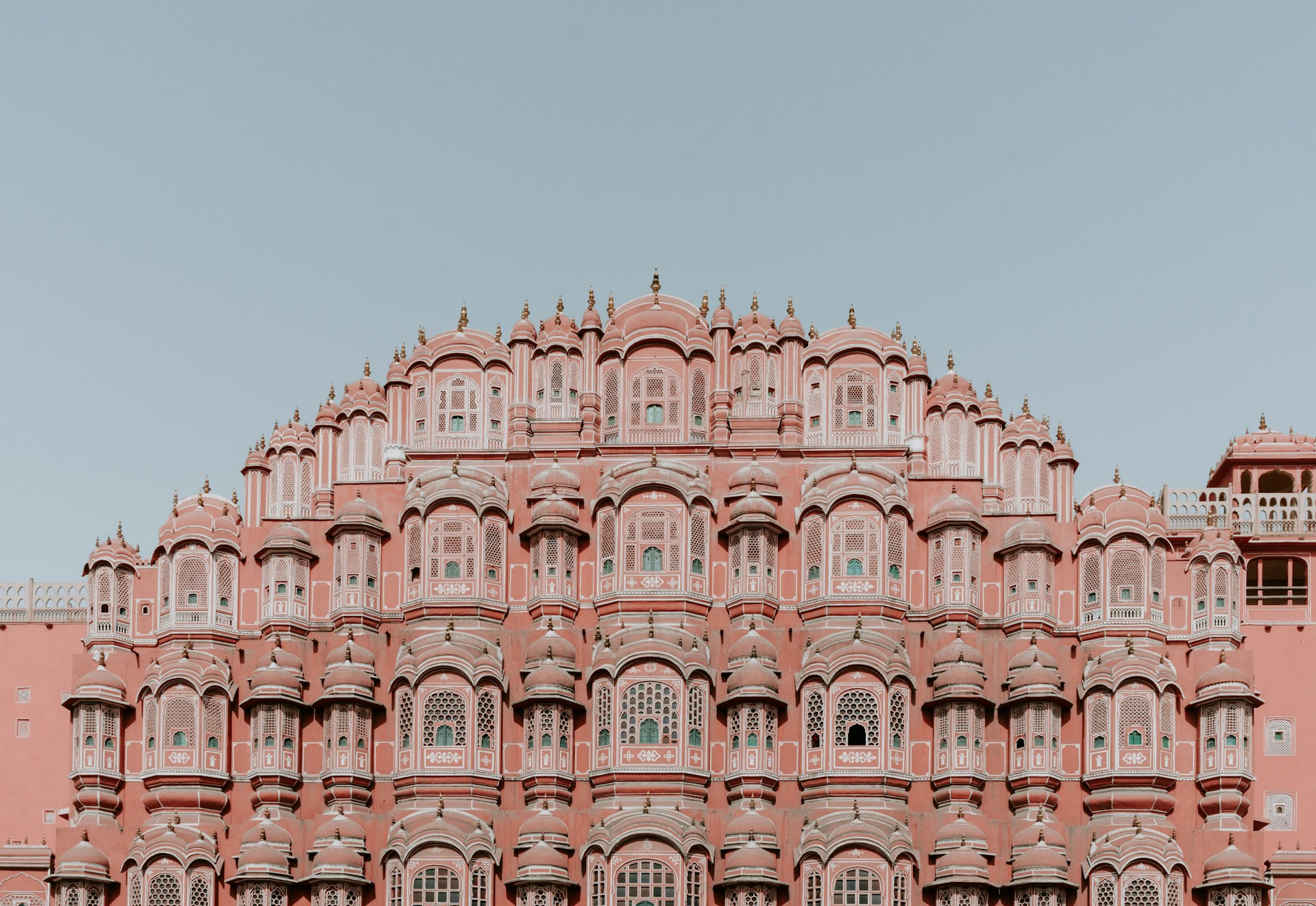
Jaipur, the Pink City of India, It was one of the most surprising stops on our trip. Part of the famous Golden Triangle Along with Delhi and Agra, it combines chaos, history, and charm in equal measure. We arrived not quite knowing what to expect and ended up traveling on the metro with families asking us about our Bollywood heroes, buying souvenirs among temples and arcades, and watching the sunset in front of the Hawa Mahal surrounded by monkeys and horns.
In this guide we tell you What to see in Jaipur in 2 days, With a real route full of tips, anecdotes, and hidden gems to discover the city's most authentic and colorful side. As you'll see, we were there for two and a half days, so our route can be done at a more relaxed pace with 3 days or more intense with only 2.
Day 1: Hawa Mahal
We arrived in Jaipur at midday, eager to rest a bit after the journey from Jodhpur. We chose [location] as our accommodation Ashok Villa, located in the Gopalbari area. This is a residential area It's quite quiet, with gates that close at night, which helps to reduce the noise from the traffic. It's a small, unpretentious hotel that we can highly recommend: the food was good, the room was clean (by Indian standards), and the service was excellent.
After eating at the hotel and regaining our strength, we set out to explore the city using its modern subway, which, by the way, works wonderfully. On the way, an Indian family made room for us to sit while they asked us such interesting questions random like who our favorite Bollywood hero was or our favorite cricketer. They told us they were visiting for a wedding, since April is wedding season in India.
Strolling through the markets of the historic center It was quite a discovery. They have arcades and sidewalks (something rare to see in many cities in the country), which makes walking much more comfortable. However, Haggling here is more complicated They know that tourists will pay more, so patience and a smile are key.
The Hawa Mahal It was our first big stop. This pink palace is one of Jaipur's icons, and although it's usually crowded with people taking photos, the best view is right across the street, from the cafes with terraces or from the opposite sidewalk (if you can manage to cross the street, of course, haha). We bought some small Ganesha figures and some souvenir magnets, and as the sun set we saw monkeys walking over the rooftops of the city (something that never ceased to amaze us throughout the trip).
Around seven o'clock, the markets began to close and the hustle and bustle gave way to the smell of the food stalls. We had dinner near our hotel at a Chinese restaurant called Daniel's Oriental Kitchen, where we ate wonderfully.
Day 2: Amber Fort, City Palace and Patrika Gate
The second day began with a bit of logistical chaos. We tried to order a Uber or a wave, But the drivers would accept the ride and then cancel it for no apparent reason. In the end, a driver from tuktuk He approached us with a smile, spoke good English, and offered us a complete tour of the city 600 rupees. We thought it was fair and we were right: he was kind, patient and even acted as our impromptu photographer.
Amber Fort and Jal Mahal
The first stop was the Amber Fort, One of the most impressive forts in all of Rajasthan, it sits atop a hill offering spectacular views, with walls winding through the mountains and a lake at its base. You'll have to walk up a short slope, where you'll be surprised to find they still use elephants to carry tourists who pay for the ride.
Some of the must-sees at this temple are:
- Ganesh Pol (Ganesh Gate): This is the main entrance to the inner palace. It is decorated with elaborate frescoes and arches, and symbolizes the beginning of the "royal tour." It is very photogenic.
- Jai Mandir (Temple of Victory): a building with several rooms, where the imposing white marble hall is located, filled with mirrors the Sheesh Mahal (Hall of Mirrors). This is the main attraction of Amber Fort.
- Mugal Garden: This is the garden visible from the Jai Mandir, designed in the classic style of the Mughal gardens (charbagh), with a fountain and vegetation to escape the heat.
Practical information for your visit:
- Open from ~8:00 a.m. to 5:30 p.m..
- Tourist entrance 500 INR approximately (check at the time).
To see it you will need between 2 and 3h Depending on how much time you spend admiring everything and taking photos. There's a part of the fort that's very.. labyrinthine And it's practically unrestored. Of course, there are no marked trails; we recommend you wander around as you please.
👀 Watch out!
There, a young man who was sweeping tried to scam us out of money (he offered to show us a cool spot and then asked for money) and a security guard (by showing us a "secret window"). Be careful with this, don't give them anything!
On the way back to the center we made a quick stop at the Panna Meena Ka Kund, an old stepped well It looks like something out of a video game. It's a photogenic and peaceful spot, perfect for a short stop before continuing on to the Jal Mahal the floating palace Located in the middle of Man Sagar Lake. It's not open to the public, but the views from the shore are beautiful.
City Palace
We finished the route at the City Palace, Located in the heart of Jaipur, the palace is a must-see. While the entrance fee is somewhat expensive, it's well worth a visit if you're interested in the history of the Maharaja and the royal halls. Part of the palace remains a residence of the Jaipur royal family, so there's a section that can't be visited independently (guided tours are available).
- Mubarak Mahal: reception hall that currently houses a museum of royal costumes.
- Diwan i Aam (Public Hearing Room) where the maharajah listened to the people, and theDiwan i Khas (Private Audience Room) for special guests, both with a very photogenic aesthetic in Jaipur's characteristic pink color. There are some silver urns giants (we're not exaggerating).
- Pritam Niwas Chowk, The courtyard with its four portals representing the seasons is very photogenic: Peacock Gate (autumn, Vishnu), Lotus Gate (represents summer and Shiva), Rose Gate (representation of winter) and Leheriya Gate (spring green dedicated to Ganesha).
- Govind Dev Ji Temple: dedicated to the god Krishna, one of the most beloved gods in Hinduism. He is considered the spiritual heart of Jaipur.
- Chandra Mahal The royal family's private residence. We didn't see it because we went in on our own, but we saw people going in with a guide.
Schedule and prices:
- The City Palace opens approximately from 9:30 a.m. to 6:30 p.m..
- For foreign tourists, the standard entrance fee is around 1000 INR per adult.
- In 1-2 hours you will have seen everything (we found some parts closed for renovations).
Right next to it is the Jantar Mantar, an 18th-century astronomical observatory, but we decided to skip it because when we asked we were told there was no shade and, given the time, it was extremely hot.
Looking to recharge and find some air conditioning, we went to Agora Coffee, A restaurant with tasteful decor and a menu that blends international dishes with vegetarian options. We ordered Pasta with tomato sauce, kombucha and some roasted chickpeas, A simple but delicious meal. It was one of the cleanest places we saw in India. It was the perfect break before continuing.
Patrika Gate and Jawahar Circle
In the afternoon we went out to explore one of the most modern and pleasant areas of Jaipur: Patrika Gate and the park right next to Jawahar circle.
Patrika Gate is a monumental arch It seems like something out of a dream. Every hallway and every wall is covered in colors, reliefs, and paintings depicting different places in Rajasthan. It is, without a doubt, one of the most photogenic of the city. Just be patient: there are usually queues of tourists and locals waiting their turn to pose. We actually arrived at dusk and there were fewer people because it's not as good at night; we recommend going during daylight hours.
Right next to it is the Jawahar circle, A circular park where people take the opportunity to stroll, play sports, or simply relax away from the traffic. It was a complete change of scenery after the chaos of the city center: trees, silence, and a much cleaner air And it's cool and fresh. In this area, you can see the newer and more well-maintained part of the city, almost as if you've traveled to another place.
We stayed to watch the fountain light and music show, which starts around 8:00 PM. Although it was a bit shabby, it has its charm and the atmosphere is very pleasant, with families, couples and groups of friends enjoying the sunset.
Day 3: Monkey Temple and local markets
Our third day in Jaipur began calmly. We had been informed at the hotel that the Vice President of the United States, JD Vance, I was visiting the city and knew there would be street closures, so we decided to take it easy before heading out to explore.
Monkey Temple (Galta Ji Temple)
When we finally managed to negotiate a tuktuk at a good price (a task that requires considerable patience), we set off for Temple of the Monkeys known as Galta Ji. This place is about 10 km from the center and is a mix between temple, sanctuary and Behold Or natural. One of the things the Uber drivers we were trying to get told us was that we had to book a round trip with them because nobody would pick us up there. We don't know if that's true because in the end we ended up taking the tuktuk who waited for us 500 INR (the taxi drivers were a bit of a rip-off), but the place is quite remote so with our bad experience with taxis we wouldn't risk it.
The first thing you should know is that There are two entrances: one from the back, with a large parking lot, And another route that requires going up and down a small hill for about fifteen minutes in the sun. We, of course, unknowingly took the difficult one. If you go, ask to be dropped off at the entrance to the parking lot, You'll save yourself the walk.
The temple, dedicated to the monkey god Hanuman, It has several sacred pools where locals bathe and a huge colony of macaques that scamper everywhere. Upon arrival, we were greeted by a monk who, with a smile, blessed us, told us some stories about the place, and placed the traditional red dot on our foreheads. All very spiritual… until it came time for the donation: he asked us 500 rupees, although in the end we gave it 100 so that she would let us leave and she accepted them, grumbling a little (in India it's like that all the time).
The place itself is curious and has something magical about it, although it also seems a bit worn out and forgotten in time. Even so, it's worth visiting to see a less touristy temple and experience firsthand that blend of the sacred and the everyday that so perfectly defines India.
Albert Hall Museum and local markets
After visiting the monkey temple and surviving the heat (and a few scares with the macaques), we made a brief stop at the Albert Hall Museum, It's one of the most beautiful buildings in Jaipur. It's right across from a park, and although we only saw it.. outside, It's worth taking a closer look to admire its architecture Indo-Saracen and take some photos. The contrast between the white domes and the blue sky is spectacular.
From there we returned to the hotel for a light meal and a short rest before heading out for what would be our last walk around the city. In the afternoon we decided explore the downtown markets, starting with Badi Chaupar and walking until Chandpole.
We loved this area: narrow streets, stalls covered with sheet metal roofs, Tiny shops packed with locals, and that constant murmur you only hear in places where life never stops. We were blown away by the typical stationery shops that were like little street stalls; India is another world.
However, after walking for quite a while amidst spices, incense, and motorcycle smoke, we began to notice how we Their eyes and throat were itchy. The mix of pollution and strong smells was a potent combination. We decided to head back towards our hotel before nightfall.
On the way, we bought some beers in a shop that was already closed because alcohol is not sold after 8 pm, and the owner literally handed them to us under the door, as if they were contraband. It was the perfect scene to end our days in Jaipur: improvised, surreal, and with that touch of charming chaos that defines India.
Transportation in Jaipur
Getting around Jaipur may seem challenging at first, but with a little patience it becomes part of the experience.
The Jaipur Metro
It was one of the biggest surprises of the trip Jaipur metro It's modern, inexpensive, and very easy to use. The stations are clean, signposted in English, and some have air conditioning (which is a huge plus). The main line connects the major tourist areas with the city center and is ideal for avoid traffic. In addition, the locals are incredibly friendly: there will always be someone willing to help you or ask you who your favorite Bollywood actor is.
Tuktuks and taxis
The tuktuks They're the most practical (and fun) way to get around the city, but be prepared to negotiate. Many drivers will try to inflate the price or give you "improvised tours," so always agree on the fare before you get on. In our experience, it works better to include more places in the tour than to try to lower their asking price. They don't mind spending the whole day with you and waiting wherever necessary.
We try to use Uber and Ola, But in Jaipur it didn't work well for us, perhaps because we were staying in a very touristy area for foreigners. We recommend trying it, as it's much better to get around by taxi, but if you don't want to waste time, go straight to the street and negotiate with the tuk-tuk drivers in person.
Full-day tours
If you prefer something more organized, there are many private tours which even include a guide Spanish-speaking. It's a highly recommended option if it's hot or if you want to make the most of your time. Be careful of surprises, though, as our friends were taken to "their cousin's shop" at the end of the tour and pressured to buy things there. Watch out for that kind of thing.
Walk through the center
Jaipur (and India in general) isn't the most walkable city, but in the historic center there are streets with arcades and sidewalks, something uncommon in India. The markets of Badi Chaupar and Chandpole They are ideal for leisurely strolls, although it is best to do so in the morning or at sunset, when the heat subsides.
Quick tips
- Always carry cash, Many places do not accept cards.
- If you travel during the warm season (March–June), Avoid the middle of the day. It's VERY hot, we're not exaggerating.
- Always carry one a hat if you're going to be in the sun and a lot water.
- Bring tissues or a light face mask: among the pollution and spices, Sometimes the air can sting.
Where to eat in Jaipur
Jaipur's cuisine is as intense as its traffic. Between the spiciness, the heat, and the aromas wafting from every corner, eating here becomes an adventure. These were our favorite stops:
Daniel's Oriental Kitchen
When we arrived in Jaipur, we were eager to try a different kind of food, having been in India for about 10 days. We thought it would be interesting to try this small restaurant.. Asian cuisine, Very clean, with air conditioning and reasonable prices. We tried several dishes and they were all delicious gyozas, Chicken in spicy sauce or Curried noodles.
Agora Coffee
Very close to the Hawa Mahal is this hidden gem for those who need a break. Modern decor, cleaning, air conditioning and a menu with international dishes, Pasta, kombucha, and vegetarian options are available. It's more expensive than the Indian average, but the peace and quiet are appreciated.
Street food and markets
If you dare, try the samosas the lassi or the spiced chickpeas at the stalls in the center. Just make sure the place is busy (the best sign that the food is fresh).
Beers and curiosities
Finding beer in India isn't as easy as it seems. Many restaurants and cafes don't serve it, either for religious reasons or because alcohol licenses are expensive and difficult to obtain. Some places.. They sell discreetly., although do not appear in the letter Just ask with a smile and they'll be happy to bring it to you (our theory is that they buy it from a street stall and bring it to you).
👇 You may also be interested in:If you want to read other articles ideal for your trip that complement What to see in Jaipur in 2 days (and what to do if you have 3) you can visit our posts about India.

 Español
 English
 Français
Leave a Reply